Total Pageviews

Showing posts with label UK traditions. Show all posts

Friday, 27 November 2015

How British is your Christmas?


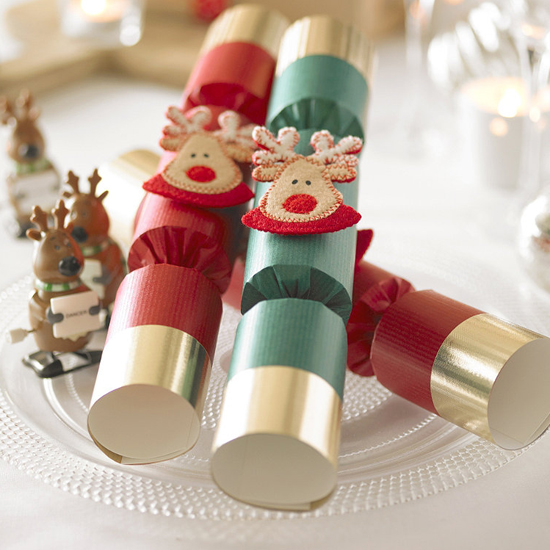
Many American Christmas traditions trace back to England, like the main staples of decorating your home, putting up a tree, exchanging presents and having a mid-day dinner. Why not British it up a bit more this year? 
From explosives at the dinner table (!) to lighting food on fire, the Brits know how to do Christmas with a bang. Anglophenia’s Siobhan Thompson looks at 10 ways to celebrate a very British Christmas in the latest episode of our YouTube series.
(BBC America)

Friday, 12 June 2015

Robin selected as Britain's national bird in vote

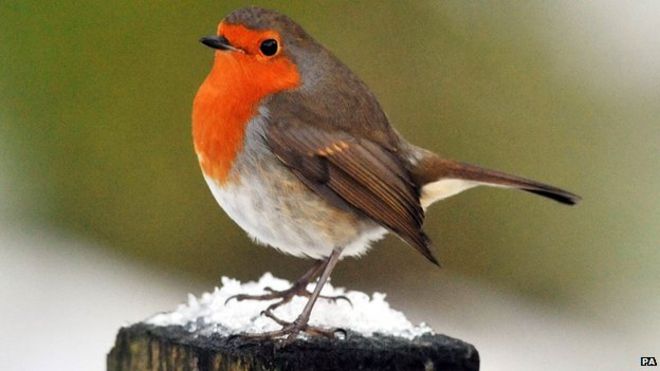
The robin has topped a poll of more than 200,000 people to choose the UK's first national bird.


A robin
Voters have selected the robin to be Britain's national bird
The red-breasted bird received 34% of votes, followed by the barn owl, which received 12%, and the blackbird, 11%.
More than 224,000 people voted online, at ballot boxes in schools and by post in the poll, which began in March.
Bird expert David Lindo - who launched the campaign - said the result was "fitting", as the robin was Britain's most familiar bird.
He added: "What has become the UK's biggest ever nature vote has reminded the British people how much they love the nature around us."
Mr Lindo said he would speak to the government to ask for the winner to be officially recognised as Britain's national bird.
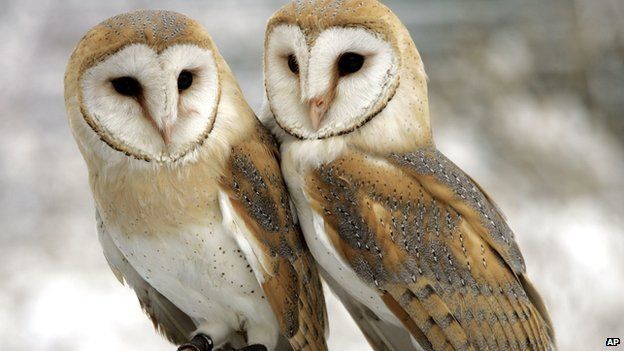
Two barn owls
The barn owl came second in the poll - receiving 12% of the vote

National birds from around the world

National birds
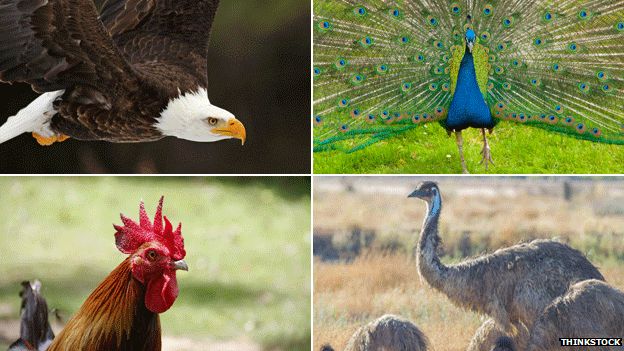
If the government agrees the robin should represent the UK, it would join the ranks of these other national birds from around the world:
  • The United States boasts the somewhat larger American bald eagle as its national bird - and indeed, national animal. It has held this status since 1782
  • The colourful Indian peacock has been the national bird of India since 1963, reportedly chosen because it's found across the country and its association with national myths and legends
  • France has the Gallic rooster as its national bird - the Latin word Gallus meaning "inhabitant of Gaul" as well as "rooster".
  • In Australia, the emu appears on the Commonwealth Coat of Arms, along with the kangaroo

From CBBC Newsround

Monday, 4 May 2015

Royal princess named Charlotte Elizabeth Diana

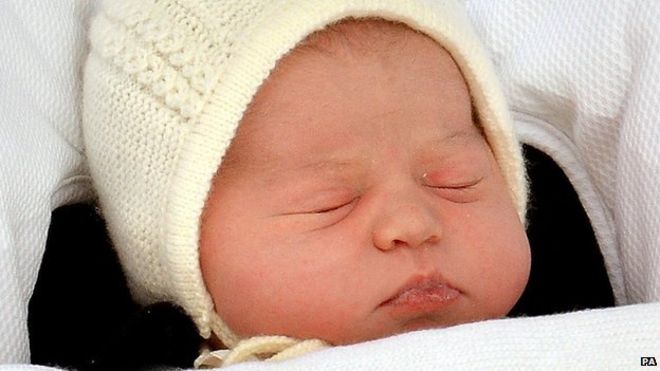
The Duke and Duchess of Cambridge have named their daughter Charlotte Elizabeth Diana, Kensington Palace has said.

The princess
The princess follows a long line of royals named Charlotte

The fourth in line to the throne will be known as Her Royal Highness Princess Charlotte of Cambridge.
She was born on Saturday in the Lindo Wing of London's St Mary's Hospital weighing 8lbs 3oz (3.7kg).
The Queen and other senior royals were told of the baby's name before the announcement was made public.
The BBC's royal correspondent Peter Hunt said that a Kensington Palace official, when asked about the couple's choice of name, said: "We'll let the names speak for themselves."

Why Charlotte?


Charlotte, the feminine form of Charles, has a long royal pedigree and became popular in the 18th century when it was the name of George III's queen.
The King bought Buckingham House in 1761 for his wife Queen Charlotte to use as a family home close to St James's Palace - it became known as the Queen's House and is now Buckingham Palace.
Charles is the name of two former Kings and of the Prince of Wales, the princess's grandfather.
Charlotte also has more recent connections for the royal couple. On the duchess's side, it is the middle name of her sister Pippa Middleton and on the duke's it is the name of his cousin Charlotte Spencer, Earl Spencer's youngest daughter.
The earl tweeted: "Perfect names. My 2-year old Charlotte Diana will be thrilled at cousinly name-sharing."
According to figures from the Office for National Statistics, Charlotte is the 21st most popular girl's name in England and Wales with 2,242 babies being given it in 2013.
Elizabeth is 39th in the list but Diana is not in the top 100.
Royal historian Hugo Vickers said the choice of Charlotte as a name seemed to be based on taste rather than history.
"I don't think she is burdened by any history associated with it and to be honest I think they just chose the name because they liked it, which is what they do and what we respect about them.
"We historians can always find someone called Charlotte but I think basically they just liked the name."
Historian Dr Judith Rowbotham of the University of Plymouth said: "None of the Charlottes in the history of the British royal family have been lacking in character and personality, so one hopes that this one lives up to that name."
From BBC News


Want to know more? Click here

Wednesday, 29 April 2015

The London bus: Britain’s most iconic design?

Beloved by locals and tourists alike, London’s bright red double-decker bus has endured to become synonymous with the city. Jonathan Glancey explains its appeal.


The post-box red, double-decker bus was never designed to be an icon. It was supposed to last just 17 years – so why is the Routemaster still with us, 50 years later?
It was designed by London Transport to be both ultra-modern and traditional, created by Londoners, for Londoners. The prototype was issued in 1954 and the first vehicles went into service two years later.
Created right after World War II, its body was made of lightweight aluminium – perhaps the most direct link with war-time engineering techniques.
When it was finally taken out of regular service in 2005, there was a public outcry at the loss of a London icon – the name was revived with a new Routemaster just three years later. But can the new bus live up to its iconic predecessor? Jonathan Glancey takes a look. 
From BBC News
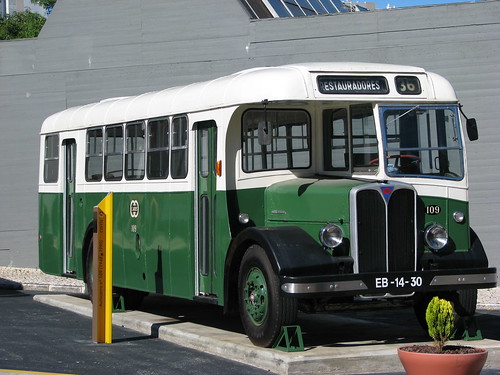
This extraordinary bus was once the choice in Portugal., too. However, its colour was green instead of red. The company which still exists was CARRIS.
There was also a smaller version a "single decker" suitable for areas where it was diffucult for a doubledecker to go. Narrow streets of ancient parts of Lisbon or simply less populated areas.
 Of course the entrance was on the opposite side of the bus as in Portugal  the driving is by the right side of roads and streets. some of these green buses had no door at the back and many people, especially men used to jump out of the bus while it was still moving (quite a few fell off and got serious injuries). Later they were painted orange and soon after some modern buses came up and these ones completely disppeared. Some were preserved and are now in the Museum of CARRIS


Sunday, 15 February 2015

A taste of the first fish and chip shop to open in Kabul

The first British fish and chip shop has opened in Afghanistan's capital Kabul, serving up a taste of the UK to locals.
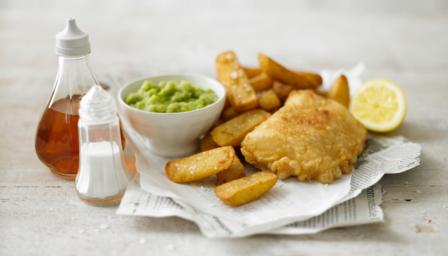
The food is served wrapped in paper, as one might expect, and the owners hope to open more restaurants around the country.


How to cook the perfect home-made Fish & Chips 

Fish and chips

Ingredients

  • beef dripping or oil, for deep frying (beef dripping is used in the traditional method and gives a far better flavour, but sunflower orvegetable oil will work just as well)
For the fish
  • 4x175g/6oz thick cod or haddock fillets, taken from the head end rather than the tail end of the fish
  • 225g/8oz self-raising flour, plus extra for dusting
  • salt and freshly ground black pepper
  • 300ml/10fl oz fridge-cold lager
For the chips
  • 6-8 large floury potatoes, such as maris piper, king edward, desiree (depending on how hungry you are)

Preparation method

  1. Preheat the oven to 150C/300F/Gas 2 and preheat the dripping or oil to 120C/250F.
  2. For the chips, peel the potatoes and cut into whatever size you prefer. Wash well in cold water, drain and pat dry with a clean tea towel. Put the potatoes into the fryer and allow them to fry gently for about 8-10 minutes, until they are soft but still pale. Check they're cooked by piercing with a small, sharp knife. Lift out of the pan and leave to cool slightly on greaseproof paper.
  3. Increase the heat of the fryer to 180C/350F.
  4. Season the fish and dust lightly with flour; this enables the batter to stick to the fish.
  5. To make the batter, sift the flour and a pinch of salt into a large bowl and whisk in the lager to give a thick batter, adding a little extra beer if it seems over-thick. It should be the consistency of very thick double cream and should coat the back of a wooden spoon. Season with salt and thickly coat 2 of the fillets with the batter. Carefully place in the hot fat and cook for 8-10 minutes until golden and crispy. Remove from the pan, drain and sit on a baking sheet lined with greaseproof paper, then keep warm in the oven while you cook the remaining 2 fillets in the same way.
  6. Once the fish is cooked, return the chips to the fryer and cook for 2-3 minutes or until golden and crispy. Shake off any excess fat and season with salt before serving with the crispy fish. If liked, you can serve with tinned mushy peas and bread and butter, for the authentic experience!
From BBC News

The traditional Fish & Chips wrapped in newspaper

Wednesday, 17 September 2014

The Cabmen's Shelters: Inside London's secret 'green sheds'


To the untrained eye, they are green sheds - an incongruous sight on the busy streets of urban London.
But these wooden structures have, in fact, been part of the street-scene in the capital since 1875 - a refuge for taxi drivers to eat, drink and take shelter from the weather.
These days, just 13 remain - and many now serve the general public at large. But cabbies remain their core customer base. Now, as in the 19th Century, they are looked after by the Cabmen's Shelter Fund - a charity.
A grant from the Heritage Lottery Fund will now ensure their place in history is recorded. The Creative Intelligence Agency, a non-profit design and arts organisation, is working with the London Transport Museum to document the shelters' past, gather oral histories from cabbies and commission art works.
Archive images courtesy of London Metropolitan Archives
Video Journalist: John Galliver
From BBC News

Thursday, 26 December 2013

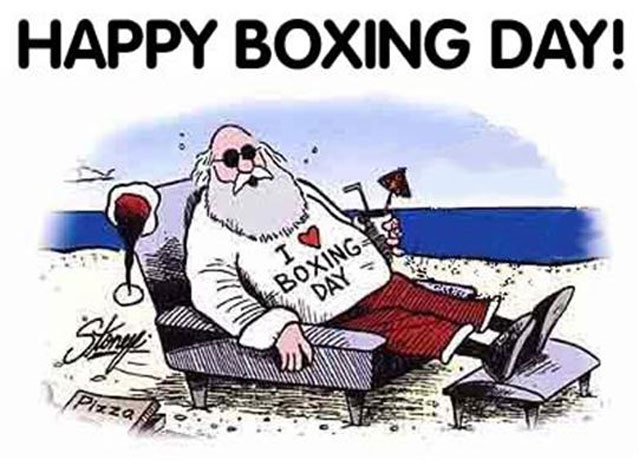
Happy Boxing Day!

Boxing Day in the United Kingdom is the day after Christmas Day and falls on December 26, St. Stephen’s Day, .Traditionally, it was a day when employers distributed money, food, cloth (material) or other valuable goods to their employees. In modern times, it is an important day for sporting events and the start of the post-Christmas sales.
Boxing Day
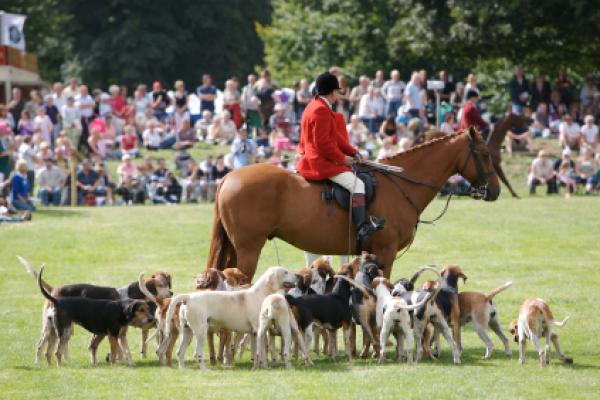
Boxing Day is traditionally day for sporting events such as fox hunting with dogs (which is now outlawed).

What do people do?

For many people Boxing Day is a time to recover from the excesses of Christmas day and an opportunity to spent time with family, friends and neighbors. Some people choose to go for a walk in the countryside, while other flock to the post-Christmas sales in large stores that often begin on Boxing Day. Some people even spend part of the night and early morning queuing to get into the stores when the best bargains are still available.
Boxing Day is also an important day for sports events. Traditionally, using dogs to hunt for foxes was a popular sport amongst the upper classes. Pictures of hunters on horseback dressed in red coats and surrounded by hunting dogs are often seen as symbolic of Boxing Day. Nowadays, fox hunting is outlawed. Horse racing and football (soccer) are now popular sports.

Public life

Boxing Day is a bank holiday. If Boxing Day falls on a Saturday, the following Monday is a bank holiday. If Christmas Day falls on a Saturday, the following Monday and Tuesday are bank holidays. All schools and many organizations are closed in this period. Some may close for the whole week between Christmas and New Year.
Many stores are open and now start their post-Christmas sales on Boxing Day. This makes December 26 a very important day for many retailers. Many public transport services run on special timetables. Many people travel to visit family or friends in this period, so bus, plane and train services can be very busy.

Background and symbols

There are a number of stories behind the origin of the term 'Boxing Day'. It used to be customary for employers to give their employees or servants a gift of money or food in a small box on this day. This is still customary for people who deliver letters or newspapers, although the gift may be given before Christmas Day. In feudal times, the lord of the manor would gather all those who worked on his land together on this day and distribute boxes of practical goods, such as agricultural tools, food and cloth. This was payment for the work that they had done throughout the passed year.
Other stories relate to servants being allowed to take a portion of the food left over from the Christmas celebrations in a box to their families and the distribution of alms from the Church collection box to poor parishioners. These traditions have evolved into the Christmas hampers that many large employers distribute, although these are now often distributed in the week before Christmas.