Do you speak more than one language?
Showing posts with label Languages. Show all posts
Showing posts with label Languages. Show all posts
Tuesday, 29 December 2015
The advantages of a bilingual brain
Do you speak more than one language?


Friday, 6 November 2015
How important is English nowadays?

In today’s global economy, English is the language of business It provides a common platform for international communication — and companies that recognize the importance of an English-proficient workforce have a competitive edge in the global marketplace.
Why English Matters, presented by the TOEIC® Program, explores this important topic. This Documentary Series offers important insights into the value of English proficiency through interviews with executives, HR directors and employees of leading multinational companies. Episodes will be released on an ongoing basis and each will highlight the importance of English — how it impacts communication, collaboration and business success.
Friday, 7 August 2015
The rise of Singlish

Singapore's famous spouting Merlion statue - in Singlish "merlion" means to vomit profusely
Singapore's government has long insisted that everyone in the island nation should speak English - it's the language used in schools, at work, and in government. But in practice many people speak a hybrid language that can leave visitors completely baffled - Singlish.
Singapore is known for its efficiency and Singlish is no different - it's colourful and snappy.
You don't have a coffee - you "lim kopi". And if someone asks you to join them for a meal but you've already had dinner, you simply say: "Eat already."
Singlish first emerged when Singapore gained independence 50 years ago, and decided that English should be the common language for all its different races.
That was the plan. It worked out slightly differently though, as the various ethnic groups began infusing English with other words and grammar. English became the official language, but Singlish became the language of the street.
Repeated Speak Good English campaigns, drummed into Singaporeans in schools and in the media, have had only limited success. Singlish has not only shrugged off these attacks, it has thrived.
It's been documented in a dictionary and studied by linguists. And it has been immortalised in popular culture. Take for example the 1991 comedy rap song Why U So Like Dat? by musician Siva Choy, which dramatises an argument between two schoolchildren.
"I always give you chocolate, I give you my Tic Tac, but now you got a Kit Kat, you never give me back!" sings Choy.
"Oh why you so like dat ah? Eh why you so like dat?"
Over time, Speak Good English campaigns have evolved from trying to stamp out Singlish, to accepting that properly spoken English and Singlish can peacefully co-exist. The language has even come to be seen as part of Singaporean identity and heritage - it appears in advertising campaigns for SG50, the big celebration of Singapore's Jubilee Year, and will feature on floats in Saturday's National Day Parade.
Do you speak Singlish? Decode these five phrases
Wah this durian so shiok, best lah!
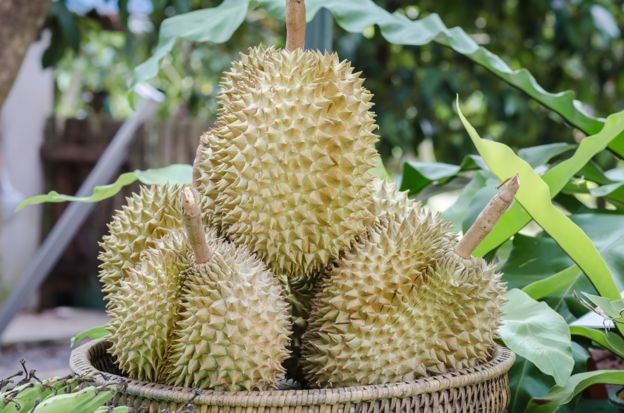
From BBC News
Saturday, 18 July 2015
What Kenya tips do you have for Obama?
Travel tips for US President Obama
About 42 indigenous languages are spoken in Kenya, with Swahili being the national language. Residents switch languages based on their location, context and who they're chatting with.
BBC collected some more travel tips for US President Obama around the BBC East Africa bureau.
BBC journalists recommended:
- Bring a mobile wifi card, so you can work in your car. Traffic can last a long time.
- Dance a traditional Kenyan jig when you step off Airforce One.
- See thousands of wildebeests crossing the Mara River. The Great Migration is happening while you're in town.
- Visit both wealthy and poor neighbourhoods to sample the city's visual diversity.
- Visit your father's grave and the surrounding area.
- Don't miss out on eating nyama choma (roasted meat).
- Make sure you visit Lwang'ni Beach in Kisumu for the best fish.
- Should you leave your motorcade behind, don't take the taxis from the airport. They are too expensive.
- Do not eat roasted maize from the road. Instead, have it made at home.
- Make sure you eat mrenda and ugali before leaving Kenya
From BBC magazine
Friday, 15 August 2014
Have some fun watching and listening to 17 different British accents
Take a quick and quirky tour through the British Isles in this new video from Anglophenia, where comedian Siobhan Thompson hilariously tackles 17 British accents – and the celebrities that speak with them, from Ozzy Osborne’s Brummie tone to the thick Scottish drawl of Billy Connolly.
Adapted from BBC http://www.bbc.com/travel/feature/20140619-one-woman-17-british-accents
Thursday, 14 August 2014
The "words"Yolo and binge-watch added to online dictionary
Yolo, adorbs and clickbait have all been added to the Oxford online dictionary.

The website keeps a record of English words and is often updated with new words.
Some of the new words...
The words will not appear in the printed version of the Oxford English Dictionary yet - but they could be added if they remain popular for many years.
From CBBC newsround
Saturday, 25 August 2012
English language 'originated in Turkey'
Modern Indo-European languages - which include English - originated in Turkey about 9,000 years ago, researchers say.


Words in common use betray the language of our past
Their findings differ from conventional theory that these languages originated 5,000 years ago in south-west Russia.
The New Zealand researchers used methods developed to study virus epidemics to create family trees of ancient and modern Indo-European tongues to pinpoint where and when the language family first arose.
Their study is reported in Science.
A language family is a group of languages that arose from a common ancestor, known as the proto-language.
Linguists identify these families by trawling through modern languages for words of similar sound that often describe the same thing, like water and wasser (German). These shared words - or cognates - represent our language inheritance.
According to the Ethnologue database, more than 100 language families exist.
The Indo-European family is one of the largest families - more than 400 languages spoken in at least 60 countries - and its origins are unclear.
The Steppes, or Kurgan, theorists hold that the proto-language originated in the Steppes of Russia, north of the Caspian Sea, about 5,000 years ago.
The Anatolia hypothesis - first proposed in the late 1980s by Prof Colin Renfrew (now Lord Renfrew) - suggests an origin in the Anatolian region of Turkey about 3,000 years earlier.
Cognate words represent our language inheritance
To determine which competing theory was the most likely, Dr Quentin Atkinson from the University of Auckland and his team interrogated language evolution using phylogenetic analyses - more usually used to trace virus epidemics.
Friday, 13 July 2012
Hobson-Jobson: The words English owes to India

In 1872 two men began work on a lexicon of words of Asian origin used by the British in India. Since its publication the 1,000-page dictionary has never been out of print and a new edition is due out next year.
Hobson-Jobson is the dictionary's short and mysterious title.
The subtitle reveals more: "A glossary of colloquial Anglo-Indian words and phrases, and of kindred terms etymological, historical, geographical and discursive. By Colonel Henry Yule and AC Burnell."
But even the word "discursive" doesn't quite prepare the reader for what is to come.
"It's a madly unruly and idiosyncratic work," says poet Daljit Nagra.
"Not so much an orderly dictionary as a passionate memoir of colonial India. Rather like an eccentric Englishman in glossary form."
Take the entry for the Indian word dam. The dictionary defines it as: "Originally an actual copper coin. Damri is a common enough expression for the infinitesimal in coin, and one has often heard a Briton in India say: 'No, I won't give a dumree!' with but a vague notion what a damri meant."
50 words from India
- A - atoll, avatar
- B - bandana, bangle, bazaar, Blighty, bungalow
- C - cashmere, catamaran, char, cheroot, cheetah, chintz, chit, chokey, chutney, cot, cummerbund, curry
- D - dinghy, doolally, dungarees
- G - guru, gymkhana
- H - hullabaloo
- J - jodhpur, jungle, juggernaut, jute
- K - khaki, kedgeree
- L - loot
- N - nirvana
- P - pariah, pashmina, polo, pukka, pundit, purdah, pyjamas
- S - sari, shampoo, shawl, swastika
- T - teak, thug, toddy, typhoon
- V - veranda
- Y - yoga
Sources: Hobson-Jobson, Oxford English Dictionary
From BBC
Subscribe to:
Posts
(
Atom
)